ABQ Ride bus service information and data.
Rider Information#
-
ABQ RIDE: Routes and Schedules
The City’s current route, schedule, detour, and trip-planning information. Consult the official service page before a trip because operational details can change.
Uptown Connect#
-
Tracks the City’s transit-centered redevelopment of the Uptown Transit Center, including design and construction progress, the transit plaza, affordable and market-rate housing, commercial space, sustainability features, and the anticipated 2026–2028 delivery schedule.
Facilities and Fleet Planning History#
-
2017 ABQ RIDE Transit General Obligation Bond Project Scopes (Archived PDF)
Details $5.9 million in 2017 transit scopes for revenue and support vehicle replacement, transit facility rehabilitation including the Yale facility stormwater permit, bus stop improvements, transit technology, maintenance equipment, and a high-capacity corridor study leveraging federal matching funds. The 2017–2025 funding summary (Archived PDF) schedules $28.341 million through 2025. Full 2017 capital-program record · Official City PDF — scopes · Official City PDF — summary
-
2009–2017 ABQ RIDE General Obligation Bond Summary (Archived PDF)
Schedules $63.25 million for revenue vehicles, park-and-ride facilities, shelters, technology, facility rehabilitation, maintenance equipment, and transit security. Full 2009 capital-program record · Official City PDF
-
Yale Maintenance Facility Assessment — Draft Final Report, Volume 1 (2015 Archived PDF)
Assesses ABQ RIDE’s Yale maintenance complex, documenting facility condition, bus circulation, maintenance and fueling operations, historic resources, space needs, design criteria, phased concepts, fleet projections, sustainability, and probable construction costs.
-
Yale Maintenance Facility Assessment — Draft Final Report, Volume 2: Appendices (2015 Archived PDF)
Preserves technical appendices supporting the Yale facility assessment, including planning maps, environmental and geotechnical records, hazardous-material surveys, building evaluations, fleet data, workshop material, cost estimates, and concept drawings.
-
2007–2016 Transit Capital Program Summary (Archived PDF)
Schedules $43.93 million for transit vehicles, West Side park-and-ride and operating facilities, shelters, facility rehabilitation, maintenance and security equipment, technology upgrades, and Central-and-Unser improvements. Full 2007–2016 capital-program record
-
2011–2019 Transit General Obligation Bond Schedule (Archived PDF)
Schedules $42.46 million for ABQ RIDE vehicles, park-and-ride facilities, technology, rehabilitation, maintenance equipment, and bus stops. Full 2011–2019 capital-program record
-
2011 Transit General Obligation Bond Project Scope (Archived PDF)
Defines the 2011 $6.2 million transit bond projects for revenue and support vehicles, park-and-ride facilities, transit technology, facility rehabilitation, maintenance equipment, and bus-stop improvements. Full October 2010 capital-program record · Official City PDF
-
ABQ RIDE 2009 General Obligation Bond Capital Scope (Archived PDF)
Allocates 7.75 million dollars in 2009 City bond funding for buses, park-and-ride facilities, shelters, transit technology, facility rehabilitation, maintenance equipment, and security improvements.
Historical System Planning and Capital Needs#
-
Transit to the Future: Short Range Transit Plan for 2006–2011 (Archived DOC)
Presents ABQ RIDE’s five-year plan for service and capital investment, documenting agency history, routes, ridership, finances, goals, demographic and travel data, system alternatives, public involvement, recommended improvements, implementation, marketing, and evaluation.
Official Legistar attachment · Official EC-06-157 matter record · Transportation Plans placement
-
Short Range Transit Planning Status and WebHoshin Transition (2008 Archived DOC)
Explains ABQ RIDE’s 2008 decision to replace separately printed annual short- and long-range plans with continuous WebHoshin performance planning, while recording the department’s federal planning obligations and relationship to the 2006–2011 plan.
Official Legistar attachment · Official EC-08-320 matter record
-
Transit 10-Year Capital Needs Assessment Status (2008 Archived DOC)
Summarizes ABQ RIDE’s ten-year capital-needs work for fleet replacement, maintenance and operating facilities, passenger amenities, and transit technology through 2030, and describes its integration into the department’s WebHoshin planning process.
Official Legistar attachment · Official EC-08-317 matter record
-
Park-And-Ride Transit Center Strategic Planning Status (2008 Archived DOC)
Documents ABQ RIDE’s park-and-ride planning process and the regional studies, transit plans, development patterns, commuter demand, funding, and candidate locations that were to inform a coordinated strategic plan for future transit centers.
Official Legistar attachment · Official EC-08-324 matter record
-
Coors and Montaño Park-And-Ride Progress Report (2008 Archived DOC)
Records the temporary Cottonwood-area park-and-ride, planned Northwest Transit Center opening, 790 Blue Line service, 2007 bond funding, and the City’s search for a permanent Coors-and-Montaño-area transit facility site.
Official Legistar attachment · Official EC-08-324 matter record
Workforce and Operations#
-
NMDOT Transit Compensation Study (2026 Archived PDF)
Compares NMDOT transit salaries with peer agencies and positions, preserving ABQ RIDE and Rio Metro pay-range benchmarks used to evaluate market competitiveness, recruitment, retention, and potential compensation adjustments.
ABQ RIDE Forward Network Plan#
-
Official ABQ RIDE Forward Project Page
Tracks the finalized bus-network plan, phased implementation, current project status, official reports, route concepts, and project contact information maintained by the City.
-
Final Recovery Network Plan (June 2025)
Defines the finalized route network, frequencies, service spans, access changes, public-input response, and phased next steps for rebuilding and modernizing Albuquerque bus service. Official City PDF
-
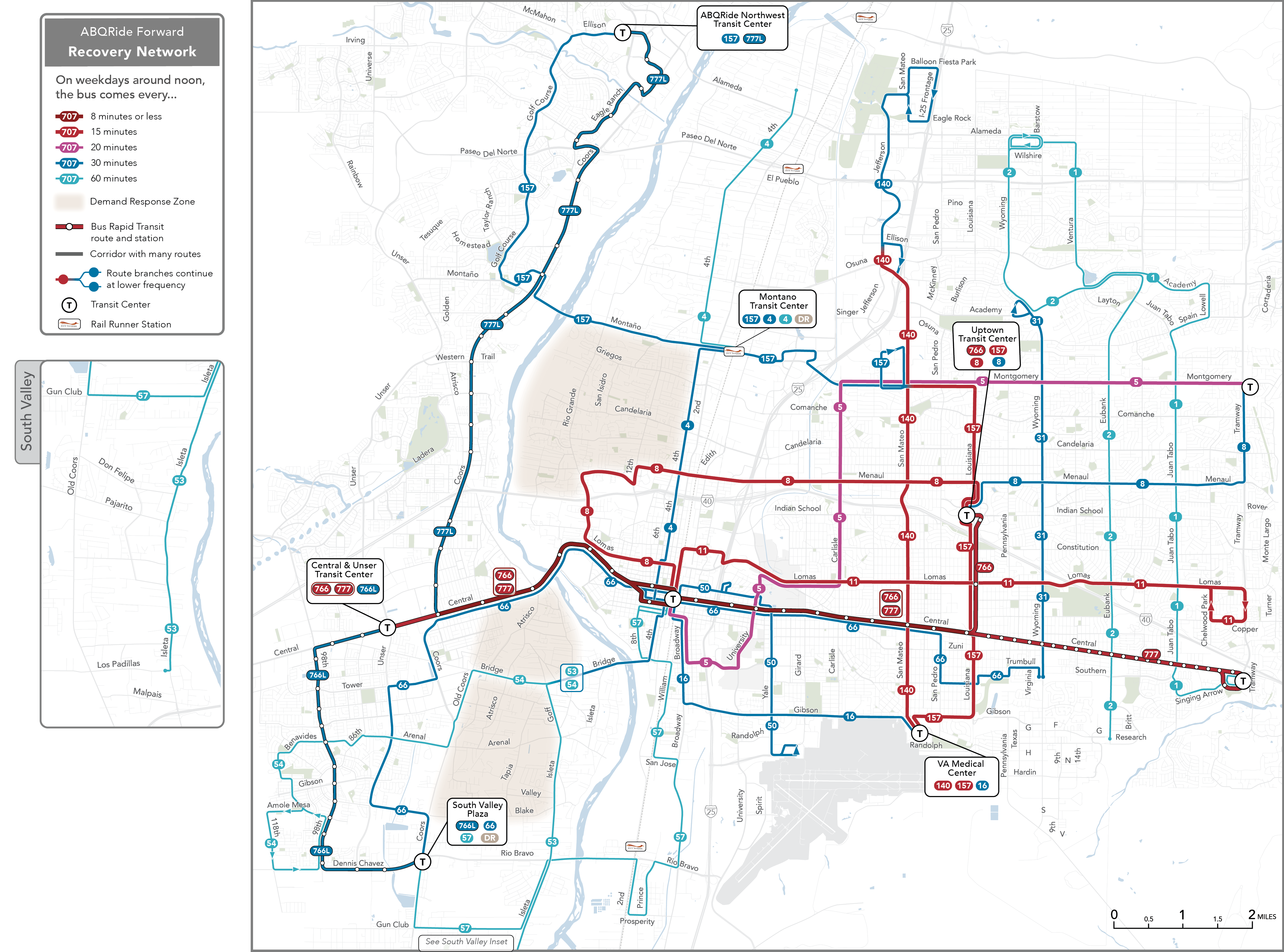
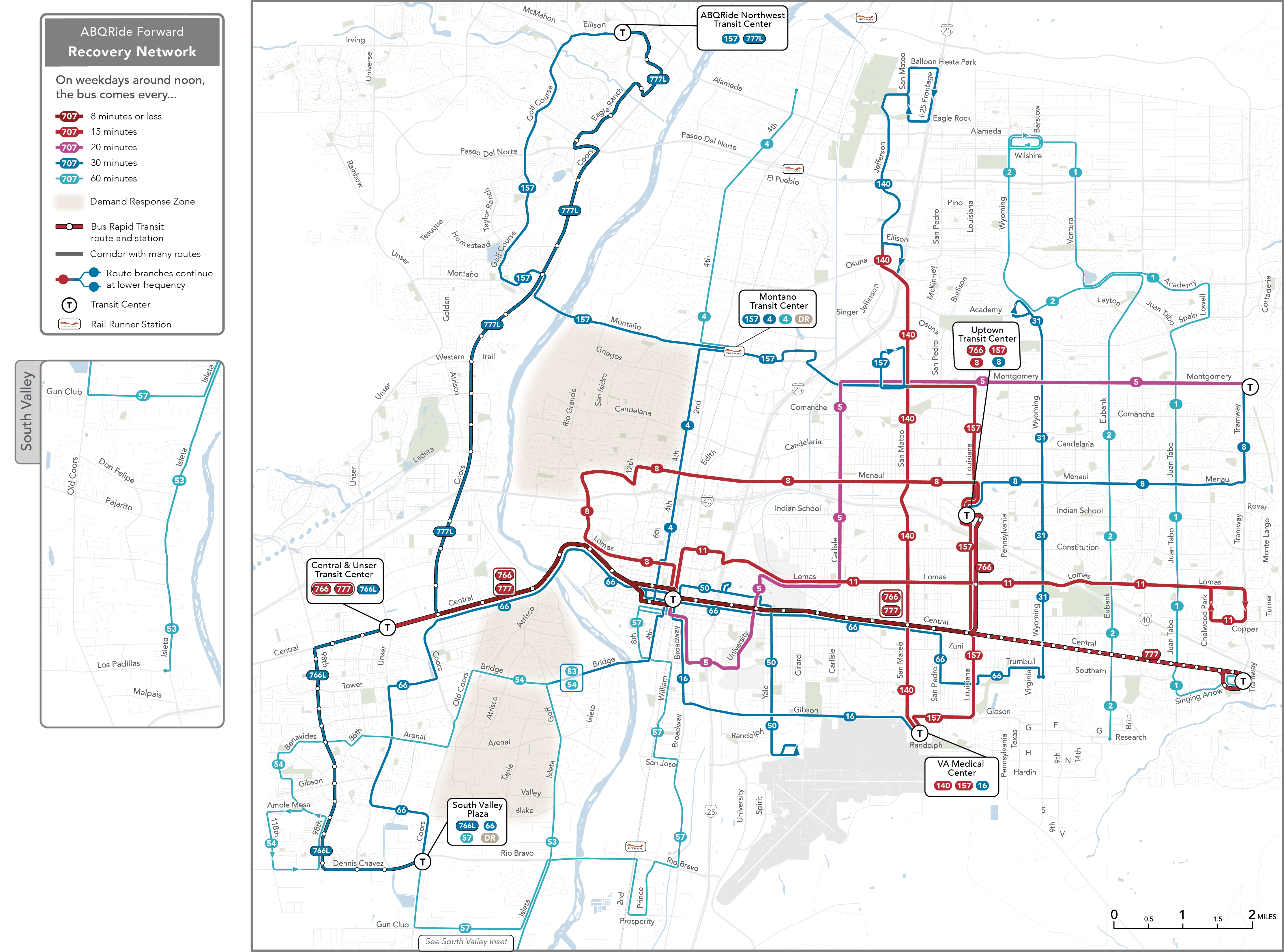
Final Recovery Network Map (2025)
Maps the finalized ABQ RIDE Forward network by route and frequency, providing a printable overview of planned fixed-route service and demand-response areas. Official City image
Planning History#
-
Phase III Recovery Network Report (May 2024)
Presents the draft recovery network, proposed route and frequency changes, service assumptions, access analysis, demographic outcomes, and recommendations later refined into the final plan. Official City PDF
-
Phase III Engagement Summary (November 2024)
Documents community and stakeholder feedback on the draft recovery network, including outreach, survey results, route-specific comments, respondent characteristics, and requested changes. Official City PDF
-
Phase II Concepts Report (March 2023)
Compares contrasting high-ridership and high-coverage bus-network concepts, explaining route structures, service tradeoffs, access outcomes, transit markets, and choices considered during redesign. Official City PDF
-
Phase II Engagement Summary (August 2023)
Summarizes public preferences between high-ridership and high-coverage concepts, including surveys, focus groups, stakeholder input, demographic analysis, and priorities for evening and weekend service. Official City PDF
-
Phase I Existing Conditions Report (August 2022)
Analyzes Albuquerque transit markets, network and route performance, ridership, service frequency, access, equity, zero fares, worker shortages, and fundamental network-design choices. Official City PDF
-
Phase I Engagement Summary (February 2023)
Records early community priorities and transit tradeoffs gathered through surveys, focus groups, pop-up events, workshops, meetings, presentations, and outreach to riders and underserved populations. Official City PDF
-
2022 ABQ RIDE On-Board Rider Survey
Profiles weekday and weekend riders, travel patterns, transfers, trip purposes, service use, demographics, automobile access, and priorities for improving Albuquerque bus service, providing the rider baseline used during ABQ RIDE Forward and later zero-fare policy analysis. City resolution citing the original survey
Project contact: Andrew de Garmo, Principal Planner, ABQ RIDE — adegarmo@cabq.gov — 505-724-3109.
ART Planning and Development History#
-
Albuquerque Rapid Transit Amended Design and Finance Plan Response (2016 Archived PDF)
Records the City’s response to Council questions about the amended ART design and finance plan, including lane configurations, property and business access, pedestrian and bicycle accommodations, parking, funding, construction, and project oversight.
Maps and Figures (Archived PDF) · Official response attachment · Official maps attachment · Official EC-16-226 matter record
-
Albuquerque Rapid Transit Design Reconfiguration Conditions (2016 Archived PDF)
Preserves Attachment A to Council Resolution R-16-24, specifying required ART design changes for corridor segments, lane widths and speeds, pedestrian and bicycle accommodations, business and property access, parking, and coordination with NMDOT.
Official Legistar attachment · Official R-16-24 matter record
-
The Scale of the Prize: Community Benefits of Bus Rapid Transit (Final Report)
Estimates the economic, household-cost, development, and community benefits of bus rapid transit along Central Avenue, providing an early City-commissioned case for the investment that became ART. Official City project page and marked draft
-
ART Corridor Building Permits, October 2022–September 2023
Maps building permits and reported construction value along the ART corridor, preserving a concise City GIS snapshot of post-project development activity. Its exact former City download location remains under review.
Selected Public Comment Record#
These documents preserve representative contemporary criticism of ART. They are identified by authorship and included as planning-history evidence, not as official City findings.
-
ART Design Comments Submitted to the Transit Department (December 2015)
Preserves detailed Coalition of Concerned Citizens comments and annotations about alignment, access, medians, intersections, business effects, and proposed design changes before construction.
-
Summary of ART Meeting with the Transit Department (December 2015)
Summarizes a meeting between the Coalition and Transit Department, documenting questions, agency responses, disputed assumptions, design concerns, and the contemporary public process.
-
Coalition Response to City ART Mythbusters (August 2016)
Records a detailed opposition response to City claims about ART, preserving debate over ridership, safety, design, construction, business effects, funding, and public process.
Montaño Intermodal Center Planning History#
-
Montaño Intermodal Center Project Application (2010 archived PDF)
Documents the City’s federal funding application for a Montaño intermodal center, connecting Rail Runner, local bus service, walking, bicycling, housing, employment, neighborhood access, and coordinated transportation investment.
Official City PDF · Official City transit document collection
Earlier Transit Investment Studies#
-
Albuquerque Streetcar Evaluation Summary Report (2008 archived PDF)
Evaluates a proposed modern streetcar through Albuquerque’s historic and cultural core, examining ridership, operations, costs, land-use and economic-development benefits, funding, implementation, and comparisons with peer systems.
-
Albuquerque Streetcar Evaluation Appendices (2008 archived PDF)
Preserves the streetcar evaluation’s supporting technical record, including peer systems, operating costs, ridership, preliminary cost analysis, land-use benefits, funding analysis, earlier HDR work, and the February 2008 introductory presentation.
-
Albuquerque Streetcar Cost and Ridership Analysis (2008 archived PDF)
Reviews the proposed Albuquerque modern streetcar’s capital and operating costs, ridership assumptions, peer systems, service design, land-use forecasts, and potential development impacts as the baseline for the broader 2008 rail-investment evaluation.
Open Data#
-
The City publishes General Transit Feed Specification (GTFS) data for applications and analysis. The live feed is preferable to an archived copy for current service information.